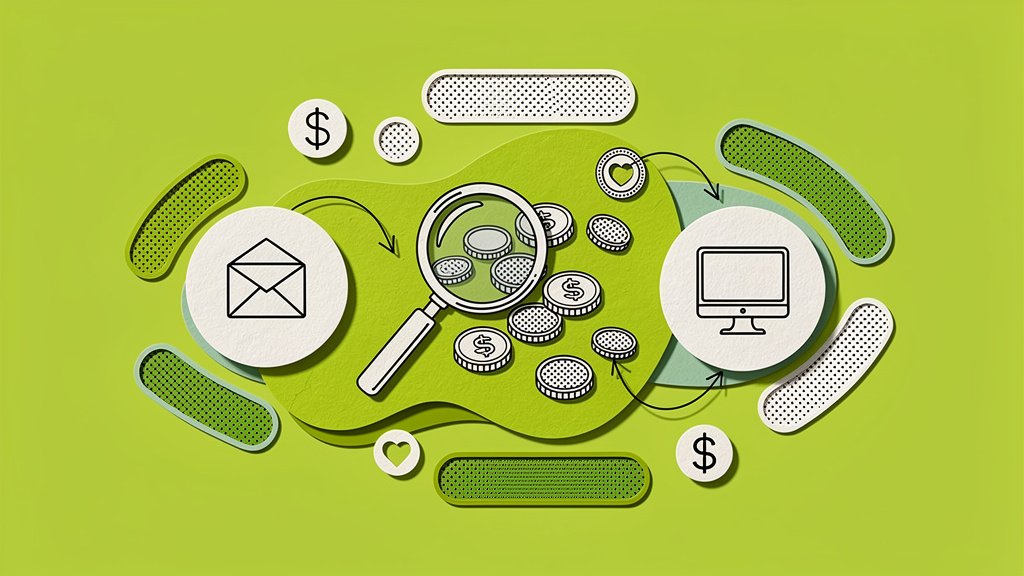
Nonprofit marketing has a quiet superpower that most organizations aren’t fully tapping into: wealth screening data. At its core, it’s about understanding not just who your donors are, but what they’re genuinely capable of giving and when they’re most likely to say yes. It’s less about being pushy and more about being precise.
In this piece, we’ll walk through how to put wealth screening data to work across your direct mail and digital ad campaigns. We’ll cover how to read the data, how to segment smartly, where digital ads fit in, and a few pitfalls that trip up even experienced teams.
What Wealth Screening Data Actually Tells You
Wealth screening software scans public records and proprietary databases to append financial capacity scores, giving propensity, and affinity data to your donor profiles (Kindsight). But the real magic is in the specific indicators, not just the scores themselves:
- real estate holdings over $1M signal high net worth and stability,
- stock ownership and business affiliations reveal both capacity and potential corporate matching opportunities,
- past charitable contributions to similar causes indicate philanthropic affinity, not just wealth,
- life events like recent home purchases serve as behavioral triggers for timely outreach (Giving USA).
This data surfaces what fundraisers call “hidden gems”. Think loyal donors who’ve been quietly giving $50 a year but actually have major gift potential. Without screening, they stay buried in your mid-tier segment indefinitely.
Funraise integrates with Kindsight (formerly iWave) to surface wealth and affinity scores directly inside donor records, so your team doesn’t need a separate login or platform to access prospecting insights (Funraise).
Protip: Before running any screen, clean your donor database thoroughly. Remove duplicates, update mailing addresses, and standardize name fields. This ensures 90%+ match accuracy and prevents wasted spend on bad data.
Applying Screening Data to Direct Mail Campaigns
Direct mail still delivers a 5.3% response rate for nonprofits, roughly 36x higher than email’s 0.1% (AFP Global / Allegra). That said, mailing your entire list at the same level wastes budget. Wealth screening lets you put resources where they’ll actually move the needle.
Segment your mail into three tiers based on capacity scores:
| Tier | Capacity Score | Mail Format | Ask Strategy |
|---|---|---|---|
| High-capacity (>$100K potential) | Top 5-10% | Executive-signed letter, premium paper | Personalized ask amount based on capacity |
| Mid-tier ($10K-$100K potential) | Next 20-30% | Impact story matched to donor affinity | Upgraded ask with matching gift mention |
| Standard (<$10K potential) | Remaining | Cost-efficient postcard or self-mailer | Standard appeal with clear CTA |
This tiered approach lets you invest in premium production for the donors most likely to respond at high levels, while keeping your cost-per-piece manageable for everyone else (Nonprofit PRO, Ask Genius).
Here’s a tactic that doesn’t get nearly enough attention: peer modeling. Identify the shared wealth markers of your top 50 past donors, then mail “lookalike” prospects from your broader list who share those characteristics. This approach can deliver a 20-30% lift in acquisition response rates (Kindsight).
Optimizing Digital Ad Campaigns with Screening Data
Upload your screened high-capacity segments to Facebook Ads or Google Ads to build lookalike audiences that mirror your best donor profiles (Virtuous). The platform’s algorithm finds users with similar demographic and behavioral patterns, extending your reach to new prospects with verified giving potential. It’s a bit like having your best donors help you find more people just like them.
Three approaches that work especially well together:
- Dynamic ask calibration. Serve different ad creatives to different wealth tiers. High-net-worth segments see “Join our $5K matching challenge” while mid-capacity audiences see “Double your $100 gift today” (Ask Genius).
- Affinity-layered retargeting. Combine wealth scores with behavioral data like past website visits. Someone who browsed your education program page and has a high affinity score for education causes gets a retargeting ad specifically about scholarship impact (Kindsight).
- Geofenced local appeals. Use real estate data from screenings to geofence digital ads around high-value zip codes, delivering hyper-local messaging to neighborhoods with concentrated giving potential.
Protip: A/B test your ad copy by wealth tier. Use urgency-driven language for mid-capacity donors (“Double your impact before midnight”) and legacy-oriented messaging for ultra-high-capacity prospects (“Join our circle of visionaries”). This alignment between tone and capacity consistently improves conversion rates.
Common Pitfalls We See Every Day
Working alongside nonprofit teams at every stage of data maturity, we keep running into the same patterns. Let’s name them.
“We screened our list two years ago and never updated it.” Wealth data decays. Job changes, real estate transactions, and stock movements shift capacity scores significantly. If you’re making decisions on stale data, you’re likely over-investing in donors whose capacity has dropped and missing those whose capacity has grown. Refreshing screens every 12-18 months makes a measurable difference (Kindsight).
“We have the data but it lives in a spreadsheet nobody touches.” This is painfully common, and it’s not a data problem, it’s a workflow problem. Screening results get exported to a CSV, emailed around, and quietly forgotten. The fix is embedding wealth data directly in your CRM so it’s visible at the point of decision-making, whether that’s building a mail list or setting up an ad audience. It’s exactly why Funraise built the Kindsight integration natively into donor records.
“We treat all high-capacity donors the same.” Capacity is not the same as propensity. A donor worth $5M with zero philanthropic history is a very different prospect than someone worth $500K who actively gives to five organizations just like yours. Layer affinity and giving history on top of raw wealth data before making any segmentation calls.
Ready-to-Use AI Prompt
Copy and paste this prompt into your preferred AI tool (ChatGPT, Claude, Gemini, Perplexity) to generate a practical segmentation plan:
I work at a nonprofit focused on [CAUSE AREA]. We recently completed wealth screening on our donor database of [DATABASE SIZE] contacts. Using the screening results, help me create a detailed segmentation plan for a combined direct mail and digital ad campaign targeting [NUMBER OF TIERS] donor tiers. For each tier, recommend: the mail format, suggested ask amount ranges, digital ad messaging angle, and one automation workflow I could set up in an all-in-one fundraising platform like Funraise.org to trigger follow-ups based on donor response. Our campaign goal is [CAMPAIGN GOAL].It’s worth investing in solutions like Funraise that have AI components built directly into the platform where you’re already managing donors and campaigns. Having full operational context, from wealth scores to giving history to communication preferences, in one place makes AI-assisted decisions far more accurate than cobbling together disconnected tools.
“The nonprofits that win aren’t the ones with the most data. They’re the ones who act on the right data at the right moment, in the channel where the donor is most ready to respond.”
Funraise CEO Justin Wheeler
Measuring What Matters
Skip the vanity metrics. Compare these three numbers before and after screening implementation:
- response rate by tier: are high-capacity segments actually responding at higher rates?,
- average gift size shift: are personalized asks driving upgrades?,
- cost-per-dollar-raised: is your targeting reducing waste?.
For context, Funraise organizations grow online revenue 73% year-over-year, roughly 3x the industry benchmark (Funraise Growth Statistics), with wealth screening and donor prospecting data playing a meaningful role in that trajectory.
Advanced Move: Hybrid RFM + Wealth Scoring
For teams ready to go deeper, consider combining traditional RFM analysis (Recency, Frequency, Monetary) with wealth capacity scores to build a hybrid ranking. A donor who gave recently, gives frequently, gives at meaningful levels, and has high capacity? That’s your top 5% for multi-channel nurture sequences. High capacity but low RFM? That’s a cultivation target, not an immediate ask.
You can also flip the lens entirely and use business affiliation data from screenings to identify corporate matching prospects or potential board candidates. Wealth screening isn’t just a solicitation tool. Think of it as an intelligence layer for your entire fundraising strategy (Virtuous).
Protip: Automate this inside Funraise. Set workflows to trigger a personalized mail merge or ad audience upload whenever a new high-capacity donor is flagged, so you never miss a window of opportunity (Funraise).
Start Small, Start Free
You don’t need a six-figure tech stack to get started. Funraise offers a free tier with no commitments, giving smaller nonprofits access to the same integrated donor prospecting tools that power major organizations. Layer in screening data, build your first tiered campaign, measure the results, and scale from there.
The data is available. The tools are accessible. The only real question is whether you’ll put them to use before your next appeal goes out.
About the Author

Top Bloomerang Alternatives for Data-Driven Direct Marketing Teams
Can you name the channel that produced last month's gift? Bloomerang alternatives compared on attribution, segmentation, and testing infrastructure.

Nonprofit Fundraising Strategy: Building Data-Driven Campaigns That Compound
Fundraising has always been about relationships. But somewhere between the thank-you letters and the year-end appeals, a lot of nonprofits end up stuck in a loop: chase donors, spend big on acquisition, watch them disappear, repeat. Sound familiar? There's a better way to think about it, and it starts with treating your donor base less…
Best Nonprofit CRMs to Run Data-Driven Direct Marketing Campaigns in 2026
Nonprofit marketing has never been more data-rich, and yet so many organizations still feel like they're flying blind. You've got donor records, giving histories, email open rates, and campaign data scattered across spreadsheets, email tools, and maybe a CRM that's technically doing its job but not quite pulling its weight. Sound familiar? So let's fix…